This Jupyter notebook is a template for a pipeline that can be used to analyse, clean, and extract basic features from smartphone and wearables data. It has been designed to be applicable to a variety of data types (e.g. step count, heart rate, screen use), and is intended to be applied to a set of data files of one specific type of data at a time. The following assumptions are made about the dataset:
There are two sections to this template. The first, data analysis uses a series of functions to analyse the data, including three main functions that give a general overview of the sampling frequency, distribution of values, and frequency of timestamp-related errors. These three main functions are likely to be neccesary for all data types. There are also additional functions for analysis tasks that are only needed for specific types of data, we will give examples of these being used in the step count,
sleep, and
heart rate templates.
The second section, data cleaning and feature extraction, uses information gained from the first section to produce a cleaned version of the data and extract features reporting meta data (e.g. total datapoints) and basic summarisation features (e.g. average heart rate, total number of steps).
All functions can be further tailored to your data in two ways:
Data analysis
In this section we will describe how to use the three main data analysis
functions. The data type sensorkit_device_usage will be used as an example,
this gives information about how much the participants interact with their
devices. First, we import all necessary functions and methods for this analysis and get a list of the
file paths:
import os
import sys
from pathlib import Path

import pandas as pd
from IPython.display import HTML, display

sys.path.insert(
    0, str(Path().resolve().parent / "src")
)  # Set the path to the src folder so that we can import the functions from there

import all_field_summaries
import calculate_durations
import clean_and_extract_features
import feature_extraction
import helper_funcs as helper_funcs
import timestamps_check

base_dir = Path.cwd().parent  # go up one level from where you're running
folder_path = base_dir / "example_data"
folder_path_str = str(folder_path) + "/"

# Set input variables
Folder_structure = 1  # This should be either 1 or 2 (see above)
csv_name = (
    "sensorkit_device_usage"  # The standard name for the csv that contains this data
)
site_list = ["test"]  # The names of the subfolders for each site
input_folder = folder_path_str  # The folder that contains all the site subfolders

# Get a list of the paths to each file to be included in this analysis
files_list = helper_funcs.get_file_paths(
    input_folder, csv_name, Folder_structure, site_list
)
4 files found
Summarise Fields
The purpose of this function is to get a general idea of the distribution of values in any fields of interest across all the data. This is likely to include measurement fields to check whether the measured values generally seem sensible. It may also include any other fields you wish to analyse, for example you might want to check that a field reporting a measurement unit gives a consistent value.
When analysing each field, the timestamp column is used to remove repeated values that occur at the same time. Different values at the same time are not removed as this analysis is intended to show the full spread of possible values rather than give a fully accurate description of the distribution, however, if required, adjustments can be made in the df_adjustment function.
Below is an example of this tool being run on sensorkit_device usage data. To tailor this to another data type, adjust the following variables:
# Edit this dictionary if you need to filter the data.
filter_dictionary = {
    # If you wish to only keep datapoints with certain values on specific rows, edit this
    # dictionary and set filter_dict in the function below to filter_dictionary. The keys
    # here are the names of the columns you want to filter by, and the values are the list
    # of acceptable entries for that column.
    "col1": [1, 3, 5],
    "col2": ["A", "C"],
}

# Call Summarise_fields
df = all_field_summaries.Summarise_fields(
    files_list=files_list,
    fields=[
        "value.device",
        "value.totalUnlockDuration",
        "value.totalUnlocks",
    ],  # The fields to be analysed.
    time_stamp="value.time",  # The name of the column that contains the timestamp.
    filter_dict=None,  # No fields need filtering so this has been left as None.
    df_adjustment_args=[None],  # No adjustments necessary for this data type.
)

# Display the results
df = df.round(
    2
)  # Rounds the numbers for ease of viewing, may need to be adjusted depending on data.
html_table = df.to_html(index=False)
styled_html = f"<div style='font-size:12px'>{html_table}</div>"
display(HTML(styled_html))In this sensorkit device usage example we have used this function to investigate
two measurement columns (value.UnlockDuration and value.totalUnlocks) and
one device column. The results can be used to check the distribution of values
for the two measurement columns so we can decide whether they seem sensible. For
this particular data type the measured values need to be considered in context
of the datapoint duration, the tool below shows this is always 900 seconds,
therefore the measured values look sensible. The results for the device column
show that two separate device types have been used. This means that we now have
to consider whether we want to use both devices or filter one out. For this
example, we have decided we are interested in phone data only. Therefore, we
use the filter_dict option to filter to just phone data for the rest of this
pipeline.
Investigate Frequency
This function analyses the time gaps between each datapoint and the durations of datapoints (if there is a duration or end time column), in an effort to understand what the expected sampling frequency of the data is. The mean, median, mode and range are given. Also included is the number of datapoints that are equal to the mode, within a (adjustable) threshold of the mode, or more than the same threshold below the mode. These are included to get an idea of whether one particular sampling frequency dominates, if there is an intended sampling frequency then the former two are likely to be high and the latter is likely to be low.
Below is an example of this function being run for sensorkit_device_usage data, using the filter_dict variable to only include phone data. To tailor this to another data type, adjust the following variables:
# Edit this dictionary if you need to filter the data.
filter_dictionary = {
    # If you wish to only keep datapoints with certain values on specific rows, edit this
    # dictionary and set filter_dict in the function below to filter_dictionary. The keys
    # here are the names of the columns you want to filter by, and the values are the list
    # of acceptable entries for that column.
    "value.device": ["iPhone"]
}

# Call investigate_frequency
df = calculate_durations.investigate_frequency(
    files_list=files_list,
    thresh=1,  # The threshold used when investigating closeness to mode.
    timestamp_col="value.time",  # Name of timestamp column
    end_time_col=None,  # No end time column, so this has been left as None
    duration_col="value.duration",  # Name of duration column.
    convert_to_unix=None,  # Left as the default as timestamp column is already in unix seconds.
    filter_dict=filter_dictionary,  # Set to the dictionary defined above to filter to just phone data
    df_adjustment_args=[None],  # No adjustments necessary for this data type.
)

# Show results
html_table = df.to_html(index=False)
styled_html = f"<div style='font-size:14px'>{html_table}</div>"
display(HTML(styled_html))Examining these results can inform you whether there is an agreement between
durations and time gaps (if expected) and can give an idea of the expected
sampling frequency and how regular the sampling is. In this example it looks
like the sampling frequency is meant to be every 900 seconds, however, there is
a substantial fraction of data points that come less than 900 seconds after the
last one. It may also be useful to experiment with different values of the
thresh variable to get a better understanding of how much the sampling
frequency varies. In this example the results do not vary much as thresh was
changed from 1 to 899, suggesting that time gaps are generally either 900 or
very small.
Check Timestamps Errors
This tool checks the frequencies of various timestamp errors. These include:
The small time gap (STG) error results come with caveat that proportion with measured values changed/not changed can vary depending on the order of neighbouring datapoints with RT+CM errors. However, the total STG will be unaffected. The threshold used to define STG errors (timegap_threshold) should be the minimum amount of time expected between datapoints. This could be determined using the expected sampling frequency (using the results from the section above) if there is one, or a sensible gap for event-based data types.
The amount records are allowed to overlap by (EAS_threshold) should be set based on what is a reasonable overlap considering the typical duration of a datapoint.
Below is an example of this tool being run for sensorkit_device_usage, again using the filter_dict variable to filter to just phone data. To tailor this to another data type, adjust the following variables:
filter_dictionary = {
    # If you wish to only keep datapoints with certain values on specific rows, edit this
    # dictionary and set filter_dict in the function below to filter_dictionary. The keys
    # here are the names of the columns you want to filter by, and the values are the list
    # of acceptable entries for that column.
    "value.device": ["iPhone"]
}

# Call get_timestamps_errors
df = timestamps_check.check_timestamp_errors(
    files_list=files_list,
    EAS_threshold=5,  # The threshold above which that datapoint will be counted as a EAS-OT.
    timegap_threshold=899,  # The threshold below which a time gap will be counted as a STG
    measurement_cols=[
        "value.totalUnlockDuration"
    ],  # A list of all measurement columns to be included.
    timestamp_col="value.time",  # Name of timestamp column
    end_time_col=None,  # We do not have an end time column
    duration_col="value.duration",  # Name of duration column.
    convert_to_unix=None,  # The data is already in unix time
    filter_dict=filter_dictionary,  # We want to filter to just phone datapoints
    df_adjustment_args=[None],  # No adjustments necessary for this data type.
    output_folder="../output/general/time_stamp_check_files",  # A folder where outputs are stored
    site_col="key.projectId",  # The site column
    participant_ID_col="key.userId",  # The participant column
)

# Show results
html_table = df.to_html(index=False)
styled_html = f"<div style='font-size:14px'>{html_table}</div>"
display(HTML(styled_html))In addition to the above table, this function also produces a csv in the outputs folder under a subfolder examples (which will be created if it does not already exist) which gives up to 20,000 examples of errors, and a csv under the participants subfolder (also created if it does not already exist) that gives details of the frequency of timestamp errors for each participant. These can be used to investigate any high values recorded in the table above further.
For this particular example we see that the STG frequency is high, this is expected based on the results from the previous section. However the errors are almost all STG-CM errors rather than STG+CM, which suggests this is not too much of a concern as long as the data is cleaned before use to prevent double counting.
Other Analyses
In addition to the functions described above, you may also want to carry out extra analyses specific to your data. Some additional functions are included in additional_funcs.py, and the use of these is demonstrated in the steps, sleep, and heart rate specific templates.
Cleaning and feature extraction
This second section summarises the results from the above data analysis, states any decisions made about how the data will be processed, produces a cleaned version of the data, and extracts features.
The metadata features include the number of RT+CM, STG+CM, STG-CM, and EAS errors in that interval (e.g. hour/day), the total number of datapoints in the interval after cleaning, and the total number of datapoints with at least one timestamp error. The latter is calculated using just the errors listed in the variable included_errors, in this example we exclude STG-CM due to the above results. You may want to add your own code for any other specific meta data features (e.g. number of datapoints over threshold) that may be required for that data type.
The basic features are straightforward summary features (e.g. number of steps in a day, average heart rate). Some simple features can be extracted by using the get_fixed_series function that is used on sensorkit device usage data below. In this case, it extracts the total screen unlock duration over all datapoints in each interval, but the agg variable could instead be set to max, min or mean to get the maximum, minimum or mean of column for all datapoints in each interval instead. However, the mean option should only be used here if the sampling frequency is consistent, for some data, such as heart rate, a weighted mean needs to be calculated instead that weights each value by the amount of time it represents. The weighted mean can be calculated using the weighted_average function in feature_extraction.py, see the heart rate specific template for an example of this being used. Specific functions combining the cleaning function and feature extraction have been written for steps and sleeps data, these can be found in the steps amd sleep specific templates. There are also functions in feature_extraction.py that may be useful for building your own feature extraction function.
The cleaned data files produced here are a copy of the data with timestamp errors fixed. RT-CM errors are fixed by simply deleting all duplicates. RT+CM are fixed by merging all datapoints with the same timestamp into one datapoint based on the meas_agg variable. If there are multiple datapoints with the same timepoint that have different durations, the datapoint/s with the highest duration that do not overlap the next datapoint are chosen. STG errors are either also merged into one datapoint if STG_fix=True, otherwise they are left as they are. EAS errors are fixed by setting the end-time/duration so that the datapoint ends when the next one starts.
Below is an example of the data cleaning and meta data feature extraction tool being run for sensorkit_device_usage. To tailor this to another data type, adjust the following variables:
In this example we then go on to extract the total unlock duration per day using the function get_fixed_series. If multiple types of features are required, for example max and min, then the function needs to be called separately each time and the outputs can either be concatenated or stored as separate csvs.
It is also important to note that for some data types you may need to do additional cleaning steps on the the output of the cleaning function before extracting features.
output_folder = "../output/"
data_type = "sensorkit_device_usage"
interval = "D"  # The interval required, here we want daily features

# Define filter_dictionary if neccesary
filter_dictionary = {
    # If you wish to only keep datapoints with certain values on specific rows, edit this
    # dictionary and set filter_dict in the function below to filter_dictionary. The keys
    # here are the names of the columns you want to filter by, and the values are the list
    # of acceptable entries for that column.
    "value.device": ["iPhone"]
}

for file_path in files_list:
    # Get ready to save files to output folder
    participant, site = helper_funcs.get_participant_and_site(file_path)
    os.makedirs(output_folder + site, exist_ok=True)
    os.makedirs(output_folder + site + "/" + participant, exist_ok=True)

    # Read in the csv as a df
    try:
        if file_path[-3:] == "csv":
            df = pd.read_csv(file_path)
        if file_path[-3:] == ".gz":
            df = pd.read_csv(file_path, compression="gzip")
    except Exception:
        print(file_path + " file cannot be read")
        continue

    # Get cleaned version of the raw data and extract metadata features
    cleaned_df, features = clean_and_extract_features.get_timestamp_errors_and_clean(
        df=df,
        interval=interval,
        time_stamp_col="value.time",  # The timestamp column
        measurement_col="value.totalUnlockDuration",  # The measurement column
        STG=1,  # The STG
        EAS_thresh=1,
        STG_fix=True,  # Setting this to True here to fix STG errors in the cleaned data files
        meas_agg="mean",  # RT+CM and STG+CM errors will be merged by getting a mean.
        end_time_col=None,  # Leaving as None as there is no end time column
        duration_col="value.duration",  # The duration column
        filter_dict=filter_dictionary,  # This is set to the dictionary above to filter to just phone data.
        convert_to_unix=None,  # The data is already in unix seconds
        included_errors=[
            "RT+CM",
            "STG+CM",
            "EAS",
        ],  # Changed from default to exclude STG-CM errors and include EAS
    )

    # Extract features from cleaned_df
    daily_unlock_time = feature_extraction.get_fixed_series(
        df=cleaned_df,
        interval=interval,
        agg="sum",  # This will give us a total of all datapoints per interval
        meas_col="value.totalUnlockDuration",  # The column we want to sum over
        timestamp_col="value.time",  # The timestamp column
        new_name="Total time phone unlocked (secs)",  # The name of the feature (to be included in the output csv)
    )

    # Save output files
    cleaned_df.to_csv(
        output_folder
        + "/"
        + site
        + "/"
        + participant
        + "/"
        + data_type
        + "_cleaned.csv"
    )
    features.to_csv(
        output_folder
        + "/"
        + site
        + "/"
        + participant
        + "/"
        + data_type
        + "_"
        + interval
        + "_metadata.csv"
    )
    daily_unlock_time.to_csv(
        output_folder
        + "/"
        + site
        + "/"
        + participant
        + "/"
        + data_type
        + "_"
        + interval
        + "_features.csv"
    )
Data Availability
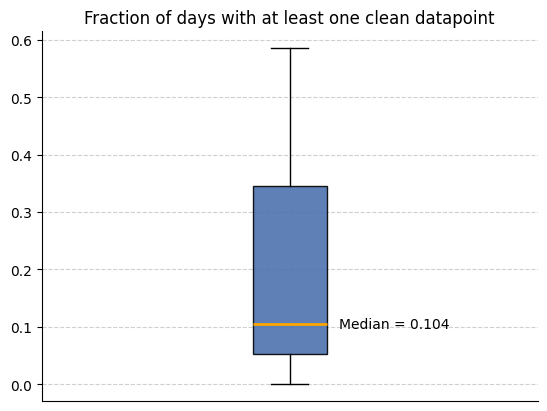
We can now use the metadata features we created to analyse how much data is available. We use the below code to look at the how many intervals (in this case days) have a non-zero amount of clean datapoints across all participants.
input_folder = output_folder  # The folder that contains all the site subfolders with the cleaned data and metadata features
csv_name = "active_apple_healthkit_heart_rate_h_metadata"
files_list = helper_funcs.get_file_paths(
    input_folder, csv_name, Folder_structure=2, site_list=site_list
)
filter_field = "Coverage (secs) from clean datapoints"  # This can be changed if you want coverage from all datapoints

all_participants = []
for path in files_list:
    df = pd.read_csv(path)
    all_participants.append(
        1 - (len(df[df[filter_field] > 1800]) / len(df[filter_field]))
    )

helper_funcs.draw_boxplot(df=all_participants, title="Fraction of days with at least one clean datapoint")
3 files found